
[ad_1]
As the SpaceX IPO approaches, a few observations and predictions:
In a real sense, the entire SpaceX value proposition rests upon the Starship project. And when I say “Starship,” I mean a Starship version that is far more capable than any we have yet seen.
-
Starship is needed to launch the heavier V3 Starlink satellites.
-
Starship — a reusable Starship — is needed to make those launches (and others for third parties) more economical.
-
Starship is needed for the promised orbital data centers.
-
Starship is needed to fulfill SpaceX’s Artemis program obligations to NASA.
-
Starship is needed for any Moon colony or Mars colony (the SpaceX IPO registration statement foretells “the emergence of new trillion-dollar markets on both the Moon, Mars, and beyond.”
But while the Starlink satellites orbit at about 300 miles above the Earth, the highest any Starship has reached (the most recent Version 3 launch, which featured the loss of both the booster and the upper stage) is only 121 miles. It’s a long way, and a whole lot of extra fuel, from 121 miles to 300 miles. Will Lockett does the math to show why the Version 3 Starship is, in his words, “functionally useless.”
And that’s before we reach the impossible physics of orbital data centers and the extreme improbability of the Starship meeting its cryogenic propellant transfer obligations in Artemis III.
(I’ve used this before, but I like it too much not to use it again.)
Now, perhaps you believe that xAI is the true key to SpaceX’s ultimate success, even if shorn of the orbital data centers. If so, I invite you to acquaint yourself with the facts that the inestimable Patrick Boyle discusses in this YouTube video (start at 10:25). As Boyle notes:
The company [xAI] whose AI product represents 93% of [SpaceX’s] claimed addressable market has a flagship product [Grok] its own engineers won’t use, and it is spending $60 billion trying to buy a competitor [Cursor] so that they can get it to work.
As for the much-vaunted $15 billion per year contract with Anthropic, Boyle makes the obvious point that xAI is leasing its competitor, Anthropic, computational power and hardware at the xAI Colossus and Colossus II data centers. This strongly suggests that xAI is, as yet, unable to make use of its own data center capacity. (Boyle makes that less obvious point that Anthropic can cancel the three-year deal at any time on 90 days’ notice.)
All these hard facts, however, will take some time to become fully evident. How much time? Two years? A year? Perhaps less?
Of this, alas, I am pretty certain: these facts will not become fully evident before the various private parties who have invested in SpaceX over the past two decades have a full opportunity to unload their shares at a massive profit on the unsuspecting public.
A confluence of rules changes by Nasdaq, the S&P 500, and the FTSE Russell all but guarantee that the SpaceX IPO will vastly enrich SpaceX insiders while raping unsuspecting retirement investors with 401k and IRA money parked in broad market index funds.
Way back on March 10, when chatter about a SpaceX IPO was still in its early stages, the eponymous author of the Keubiko’s Musings Substack posted a prescient piece called Nasdaq’s Shame (subtitle: “How to rig an index to appease a billionaire.”)
Not only did Nasdaq gut its “seasoning” requirement to allow SpaceX into its index only 15 days after its IPO, it also changed how it adjusts its weighting in the Nasdaq 100 index for “low-float” stocks.
SpaceX will be a very low-float stock, with only 5% of its shares available for sale, yet Nasdaq will weight the stock as if the float were 15% of total SpaceX shares. Per Keubiko:
The index is applying a phantom, mega-dollar weighting to a restricted, tightly-held float. Tens of billions of dollars of price-insensitive, passive capital are legally mandated to aggressively bid for the stock over a matter of days. You are effectively forcing a firehose of mega-cap index capital through a garden hose of actual liquidity. It is a recipe for a massive, artificial supply-and-demand squeeze.
Oh, but it gets worse. Much worse. Where, as Keubiko writes, the math becomes “truly sadistic.” Once the 180-day lock up period for insiders ends, and the SpaceX float exceeds 20%, Nasdaq will weight the stock based on 100% of the shares outstanding.
Musk, of course, has perfectly timed the end of the lock-up period with the moment that Nasdaq rebalances its index in mid-December. Again, Keubiko:
[Index funds will be] legally mandated to aggressively buy billions of dollars more of the stock the exact moment the insiders are able to flood the market with their unlocked shares. Can you feel your baggy liver turning to foie gras yet?
Since Keubiko first blew the whistle in his piece, a host of financial journalists and market experts have awoken to what’s afoot. You can now find scores of articles describing how Nasdaq’s rewriting of its rules will assure that millions of passive investors (the regular Joes and Josephines out there whose retirement money is invested in a broad market index funds) will be forced to buy SpaceX shares at absurd valuations.
In the great race to the bottom, the S&P 500 has now altered its own rules to “fast track” index inclusion with no requirement that the company at issue demonstrate sustained profitability.
Predictably, desperate not to be left behind, the FTSE Russell indices quickly followed suit.
Phil Bak is getting lots of traction with his superb Substack post, The Rikishi Moment, whose name derives from a deep humiliation suffered by the late, great (but deeply flawed) baseball player Pete Rose.
Bak well appreciates what a gift John Bogle, who invented low-fee index funds while at Vanguard, gave the average investor. But what was once an extraordinarily beneficial market tool has become an instrument of evil in the hands of the cynical and the unscrupulous. Writes Bak:
John Bogle is no longer with us, and I can only imagine how he would look upon what is happening to index funds now. I can only imagine the same sad eyes. I can only imagine the same dazed and tired acceptance, as his great invention coming from such great heights collapses into the sewers of fraud.
That seems too easy a question, doesn’t it? Elon Musk, of course, and his cadre of long-time enablers such as Antonio Gracias, Steve Jurvetson, and Ira Ehrenpreis.
But the beneficiaries go well beyond the Musk cabal. As the brilliant Rupert Mitchell (he of Blind Squirrel Macro) said on a recent podcast:
Pretty much anyone who is anyone has had the opportunity to buy SpaceX — and has bought SpaceX — over the course of the last 20 years. And, trust me, every body owns it.
There’s not a sovereign wealth fund, there’s not an institution, there’s not a mutual fund, there’s not a private equity shop, there’s not a crossover hedge fund that doesn’t own this thing — in size — at a much lower price than what is being offered [to the public in the IPO].
And, no surprise, guess who we can add to Rupert’s list:
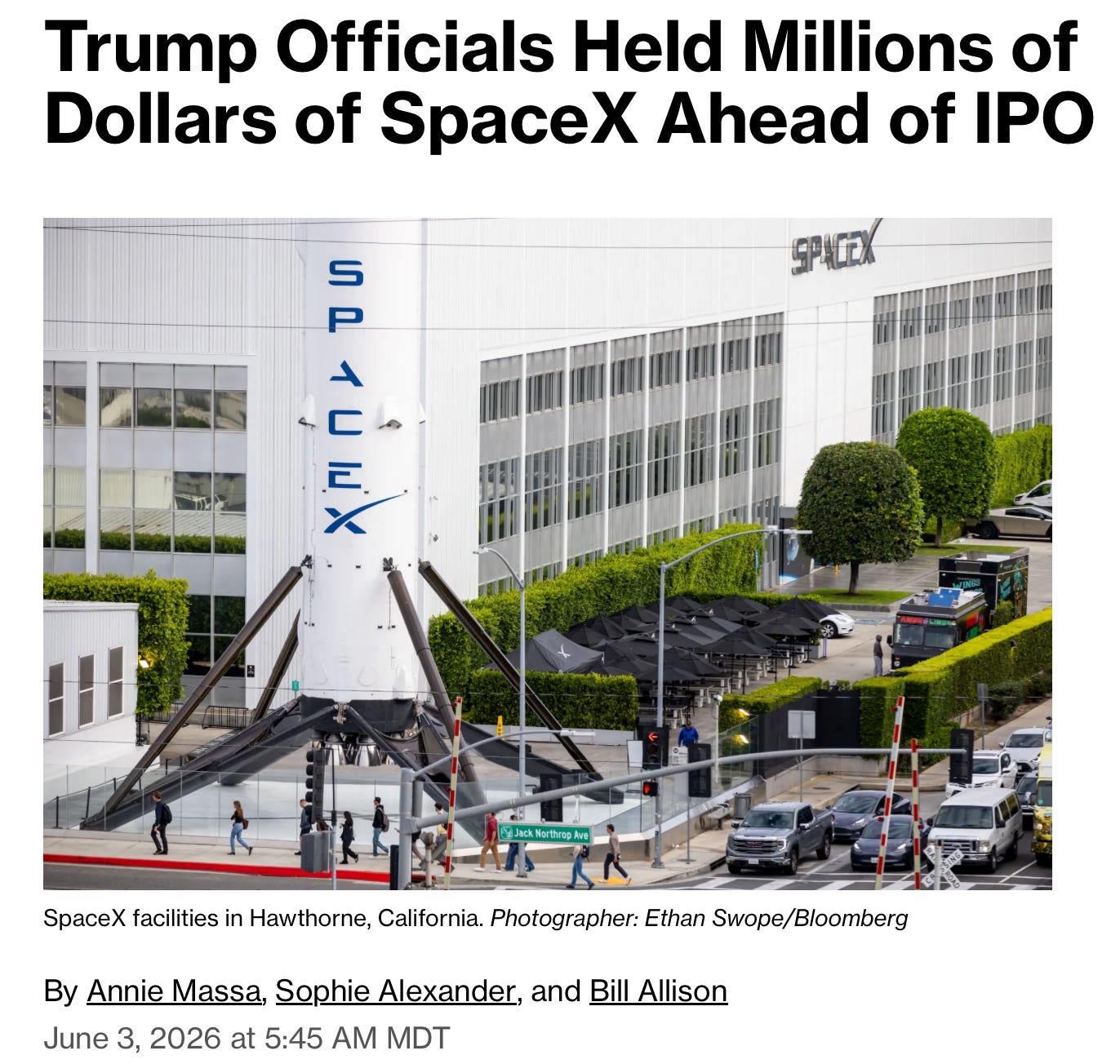
(Here’s the link. We are governed by a kleptocratic kakistocracy.)
An easy question to answer: disappointing business results (see Part I of this post) and endless dilution.
The SpaceX IPO, including the “shoe,” will raise only a maximum of about $85 billion. But a careful reading of the registration statement reflects (and Greg Collins of Cape Fear Advisors has undertaken such a reading) that SpaceX will have some $235 billion in capital needs through 2030.
If you assume SpaceX raises $85 billion in the IPO, and uses $20 billion to retire debt, that leaves a $170 billion shortfall. (Collins sees a somewhat smaller raise and larger gap, but it’s a huge gap all the same.)
One obvious solution, of course, would be to raid Tesla’s cash, whether by means of a merger or further forced investments in SpaceX. But Tesla doesn’t have nearly enough cash to feed the SpaceX cash-burning furnace.
The future will be — as even the S-1 foretells — endless dilutive capital raises: Nestled in the depths of SpaceX’s amended S-1 is this warning:
We may issue a significant amount of equity in connection with future transactions.
Even that is arguably misleading. Not the part about future significant issuances of equity; that will no doubt happen.
But will those issuances be for “future transactions”? Don’t you mean, Elon, for the transactions already promised by SpaceX in its S-1?
As to this and any other possible misrepresentations or falsehoods in the registration statement, or present or future misbehavior by Musk and his fellow officer and directors, there won’t be a damned thing any aggrieved investors can do about it.
SpaceX shareholders are signing on to mandatory arbitration. They have no meaningful voting rights. And governance disputes will be decided in a brand new Texas Business Court presided over by Musk-friendly judges (no juries allowed).
In no particular order, and mindful that the only law Elon Musk cannot break with impunity is the Law of Unintended Consequences, here are some final thoughts:
The SpaceX IPO could fail spectacularly at the outset or, indeed, even be postponed or cancelled. There simply might be far too much stock looking for a home than there is money to soak it up.
Rupert Mitchell and Ben Brey discuss these possibilities in their exceptionally informative written report and follow-on podcast.
SpaceX is offering an unheard of 30% to retail investors, and they’ll have to come up with the cash from somewhere.
Thus, the IPO could cause major and disruptive selling — stocks and crypto are the two obvious candidates — by those raising cash to participate. Indeed, the downward pressure on $BTC in recent weeks might be partly attributable to such selling (with Michael Saylor recently adding fuel to the fire.)
Chris Irons of Quoth The Raven fame views the SpaceX IPO as a referendum on the continuing inflation of what he regards as a bubble in AI investing.
A successful launch with overwhelming demand means investors continue, despite so many red flags, with their willing suspension of traditional investing discipline. But a disappointing result could be the beginning of the end for this investing cycle.
(In a recent podcast with Adam Taggart, Chris discussed his characterization of today’s financial markets as “a digital casino on cocaine.”)
Index funds for decades have offered regular people — those lacking financial sophistication but needing to invest for retirement — the opportunity to enjoy broad market exposure at very low fees.
The SpaceX IPO is a huge trap for those regular people. If what I see playing out does play out, those people will be forced to buy at hugely inflated prices, only to see the value of what they bought suffer inevitable declines.
It could prove to be a big enough black eye for index funds that 401k sponsors and administrators, and financial advisors generally, cease to recommend them as appropriate investing vehicles.
Elon Musk is a cult figure. Moreover, he has again and again proven himself immune to any meaningful market, legal, or regulatory scrutiny.
Musk’s detractors have been correct about Tesla’s terrible fundamentals, its Full Self-Driving lies, its robotaxi fantasies, its shaky accounting. But when they have imagined these things might affect the stock price, they have been wrong.
Someday, someone, somewhere will make a lot of money shorting Tesla or SpaceX. But it’s unlikely to be you.
For now, Tesla remains better understood as a religion than a financial investment, and we can now add SpaceX to that category.
So my advice is: just stay away. Tend your garden. Play with your children. Read a good book. Listen to a great piece of classical music. Here’s a recent recording I can enthusiastically recommend.
[ad_2]
Source link


