
[ad_1]
Verdict
The Razr Fold is a stylish and impressively polished first book-style foldable from Motorola, getting the big things right with lovely displays, a minimal crease, dependable battery life and a genuinely strong camera setup. It’s not quite flawless, with overcooked AI features and performance that doesn’t feel fully unleashed, but it still makes a very compelling case for itself as one of the best foldables around right now.
-
Luxurious tactile foldable design
-
Lovely crease-light inner display
-
Excellent battery life
-
AI feels bloated
-
Chipset feels underpowered
Key Features
-
Review Price:
£1799
-
Minimal crease display
With a barely-there crease running across its expansive 8.1-inch inner screen, the Razr Fold feels more polished than most first-gen foldables.
-
All-day battery life
With a huge 6000mAh silicon-carbon battery, the Razr Fold lasts all day without the battery anxiety that still plagues some foldables.
-
Capable triple cameras
With a big-sensor 50MP main, a useful 3x telephoto, and an autofocus-enabled ultrawide, the Razr Fold offers more flexibility than many rivals.
Introduction
Much like Motorola’s most recent flip-style Razrs, the Razr Fold isn’t trying to reinvent the foldable formula so much as dress it up a bit.
It’s the company’s first proper book-style foldable, sure, but rather than chasing headline-grabbing gimmicks or a wildly different take on the form factor, Motorola seems more interested in proving that it can do the basics well – and make the whole thing look and feel a bit more luxurious in the process.
That means a classy, tactile design, a pair of genuinely lovely displays, a much more capable camera setup than you might expect from a first-gen effort and enough battery life to make it feel practical as a daily driver, not just a flashy bit of kit.
It’s not without compromise, of course, but for a debut attempt in a category this competitive, the Razr Fold feels surprisingly assured. The question is whether that’s enough to trouble the best foldables around.
Design
- Tactile, luxurious, leather-like finish
- Elegant, curvy, sophisticated look
- Decent dust and water resistance
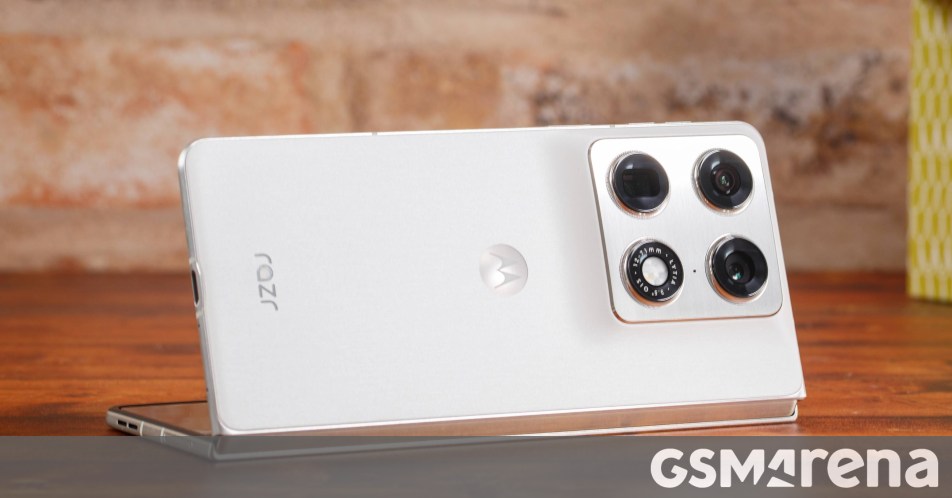
Much like the flip-style Razr 70 Ultra, the book-style Razr Fold aims to set itself apart from other foldables not with a wildly different design, but with its style. It’s safe to say that the Razr Fold is one of the better-looking foldables around right now, with a much more tactile experience than what you’ll get from the glass-backed competition.
The Lily White finish I have for review, for example, sports a satin-esque texture on the rear that feels silky and, oddly, a bit cushioned – even though it isn’t actually depressing when you hold it. It feels like really soft, good-quality leather, even if it is actually faux. It’s about as far as you can get from a fingerprint magnet as a result, and it won’t shatter like the glass-backed foldable competition if it gets dropped either.
That’s matched by a slightly off-silver, slightly beige, shade that runs across the aluminium frame, hinge and camera housing, playing nicely with the off-white colour of the rear panel to deliver something that both looks and feels luxurious.
If that’s not to your liking, it’s also available in Blackened Blue, with a matte, fabric-inspired finish. Both are, of course, Pantone-certified, in keeping with the fashion focus of Motorola’s foldable competition, though I must say, the Lily White model I have is delightful. I very rarely like the look of white(ish) phones these days, but the Fold might’ve just changed my mind.
Elsewhere, the Razr Fold takes on a slightly curvy look, with a rear camera module that looks like it protrudes directly from the rear panel with a pleasuring curvature, and the sides, while technically pretty flat, offer slightly rounded edges. It’s still pretty flat-edged overall, but look a little closer and the hints are there.
It also ties into the cover screen quite nicely; despite being a largely flat panel, there’s an ever-so-subtle curvature on the top, bottom, and right-hand sides of the screen, making swiping in from the sides feel much nicer without straying into proper curved-screen territory. A very nice touch indeed.
It’s also pretty durable for a foldable. While it doesn’t quite reach the lofty heights of the Pixel 10 Pro Fold’s full IP68, the combination of IP48 and IP49 should give you some peace of mind that it’ll at least survive a stint in the rain.
Screens
- Expansive, vibrant, 8.1-inch inner screen
- Foldable crease is pretty minimal
- Fast, bright, capable cover screen
The Razr Fold might be Motorola’s first book-style foldable, but it’s certainly not its first foldable – it actually released a flip-style foldable phone at the same time as the original Galaxy Fold back in 2019, and its flip-style Razrs give Samsung’s Flips a good run for their money. So, safe to say it has quite a bit of experience in foldable screen tech, and that means that the Razr Fold doesn’t have the same foldable foibles as other first-gen book-style foldables.
I’ll start with that inner screen because it’s a proper treat for the eyes. The panel is wide and expansive at 8.1 inches, with pOLED tech delivering the vibrant colours and deep blacks we’re accustomed to seeing at the top end of the market, and a super-smooth 120Hz LPTO refresh rate keeping everything feeling responsive.
Though the almost perfectly square 1:1 aspect ratio isn’t necessarily ideal for wide-screen gaming or watching 21:9 Hollywood blockbusters, it does provide a great canvas for multi-app use. It’s plenty big enough to run two apps side-by-side, or even more if you take advantage of the windowed app mode – but more on that a little later.
Crucially, the crease here is minimal – and I must admit, I wasn’t expecting that. The flip-style Razrs always had pretty minimal creases, but you could still feel them under your finger as you swiped along the panel. That’s not really the case with the Razr Fold; to my eyes, it’s closer to the almost-invisible crease of the Oppo Find N6 than that of the Samsung Galaxy Z Fold 7.
It essentially gets rid of the most common complaint about foldables – that visible crease – and lets you focus more on what’s actually happening on screen. Of course, it is still there if you’re really looking for it (especially if looking off-centre), but I totally forgot about it within minutes of using it.
I think the only real barrier that remains, not only for the Razr Fold but foldables in general, is the plastic screen; it’s a nightmare for warped reflections, especially in daylight. The Razr Fold is perfectly legible in daylight thanks to its 6200 nit peak brightness, but it’s not exactly reflection-free.
Close that inner screen and you’ll find a more compact 6.6-inch pOLED cover screen. Like most other foldables right now, it’s a little taller and narrower than regular candybar phones, and that means that content can feel a little squashed at times – but aside from that, it’s every part a flagship panel.
It offers a faster 165Hz LTPO-enabled refresh rate than the inner panel and clocks in at a near-identical 6000 nits peak brightness, making it a perfectly decent panel for scrolling through TikTok, playing games or using any other app that doesn’t look quite right on that boxy inner screen. And it’s much easier to quickly reply to incoming messages too.
I think the only (very minor) complaint I have about the cover screen is the bezels; coming from the Find N6 and its super-slim bezels, the bezels around the outer screen look comparatively thick. But honestly, it’s easy to overlook if you haven’t used the N6 – and seeing as it’s not available in the UK or US, most of you probably haven’t.
Cameras
- Impressive main camera with a big sensor
- Solid zoom performance from the telephoto lens
- Slight issues capturing vibrant reds
Much like the rest of the Razr Fold, the camera setup aims higher than you might expect from a first-gen book-style foldable.
On paper, it’s a very capable trio: a 50MP main camera with a large 1/1.28-inch sensor, a 50MP 3x periscope telephoto, and a 50MP ultrawide with autofocus. That main sensor is particularly notable because it’s the largest sensor on a foldable camera yet, edging past the already impressive setup of the Oppo Find N6, which I was a big fan of a few months ago.
As expected, that all translates into genuinely strong results in everyday use. In good light, all three rear cameras are capable of crisp, detailed shots, with the main lens in particular delivering vibrant images with plenty of punch and reliable dynamic range.
It’s the most impressive of the bunch by some margin, offering the kind of solid all-round performance that you’d hope for from a premium foldable, and it continues to hold up nicely once light levels start to drop too.
The telephoto is another real highlight. Zoom cameras can often feel like an afterthought on foldables, but that’s not really the case here; the 3x optical lens is genuinely useful, and it’s especially well suited to portrait photography, whether you’re leaning on Portrait mode’s artificial bokeh or not.
Detail remains strong, colours are nicely balanced, and you can push beyond the native zoom to around 10x before artefacting becomes too obvious. It even remains fairly dependable at night, though like most telephotos, it needs a decent bit of ambient light to really shine.
The ultrawide is the weakest of the three, though that won’t come as much of a surprise; that’s usually the lens that gets the least attention, even on expensive phones. Still, it’s far from a write-off.
It’s perfectly good for scenic shots, group photos and all the other wide-angle staples, and the autofocus adds a little flexibility for closer subjects too.
Colour consistency across the lenses is also generally strong, which is always good to see on a foldable where secondary sensors can often feel a little disconnected from the main camera.
That said, Motorola still seems to have a bit of a blind spot when it comes to particularly vibrant reds. Roses and similarly punchy red subjects can look a little off, and in some shots there’s an odd texture to those areas when viewed on the phone itself. It’s something Motorola has struggled with before, so it’s a shame it hasn’t been fully ironed out here.
Performance
- Rapid, smooth, flagship daily performance
- Handles demanding games well
- Chipset not running at full power
When it comes to the daily use of the Razr Fold, you’re not going to be left wanting for more with the Snapdragon 8 Elite Gen 5, a very healthy 16GB of RAM (especially amid the current RAM crisis), and 512GB of storage under the hood.
As you’d expect from the flagship chipset from Qualcomm, everyday performance is about as rapid as it can get. Apps flow smoothly, no doubt aided by the LTPO-enabled refresh rate, there’s no stuttering in media-heavy social media timelines, apps open and close near-instantaneously, and it can easily run multiple apps on-screen at once – more on the latter a little later.
It also translates to a pretty decent portable gaming rig, handling both casual games like Archero 2 and more demanding games like The Division: Resurgence run without much complaint. It does get warm during extended play, but not as hot as other foldables.
That sounds great, but looking at benchmark test results, it seems there’s a reason it doesn’t get too hot; the chipset isn’t actually being fully utilised.
Compared against the Oppo Find N6 that uses a seven-core version of the Snapdragon 8 Elite Gen 5, rather than the full-fat eight-core supposedly in the Razr Fold, the N6 still bests the Fold across most CPU, GPU and AI tests – and by quite a margin in places. I even ran each test multiple times to make sure the results weren’t anomalous – but they weren’t.
Test Data
| Motorola Razr Fold | Oppo Find N6 | Samsung Galaxy Z Fold 7 | |
|---|---|---|---|
| Geekbench 6 single core | 2620 | 3571 | 2318 |
| Geekbench 6 multi core | 9348 | 9677 | 8828 |
| Geekbench 6 GPU | 17196 | 23961 | – |
| 3D Mark – Wild Life | 5374 | 6398 | 5574 |
| 3D Mark – Wild Life Stress Test | 77.5 % | 53.6 % | – |
| 3DMark Solar Bay | 35.1 | 46.9 | – |
This would usually be explained by not turning on a phone’s system-wide ‘performance mode’ that gives full access to the chipset regardless of power drain, but that’s not an option on the Razr Fold. You can add all your demanding apps to the phone’s ‘Game’ mode, then activate turbo mode via the overlay for each app, but in my testing, it didn’t noticeably boost performance.
Now, it does mean that, as I say, the Razr Fold doesn’t get as hot as other foldables during sustained gameplay – but I also want the option to use my phone’s chipset at full power if I decide to. Not even necessarily for gaming, but for, say, speeding up exports in CapCut Mobile.
As it stands, it’s more in line with the year-old 8 Elite in the Z Fold 7 than ‘true’ 8 Elite Gen 5 phones. It’s not something that’s generally reflected in day-to-day use right now, but in time as app demands grow, it likely won’t be able to keep up as well as other Snapdragon 8 Elite Gen 5-equipped phones would.
Software
- Android 16 with a few Moto tweaks
- AI integration feels bloated
- Thoughtful foldable-specific features and 7 years of support
It used to be that, aside from Google’s Pixel range, Motorola offered the cleanest implementation of Android around. While most OEMs use highly customised versions of the latest Android software, Razrs offered something close to stock without all the gimmicky bells and whistles.
But in the past few years, Motorola has started to drift off-course – and it’s mainly down to AI. Because of course it is. It’s the new trend in smartphones in general, and it’s clear that Moto thought it was missing out on all the fun – the problem is that the current implementation is, well, a bit much.
In addition to Gemini, the go-to AI assistant, you’ve got Moto AI, Motorola’s own LLM-powered assistant that can do things like summarise your notifications, take notes in conversations and generate images. That’s fine, but it doesn’t stop there; it also adds integration for Perplexity and CoPilot, allowing you to access those chatbots from within the Moto AI window.
With four LLMs accessible via a combination of software and hardware – both Gemini and Moto AI have dedicated buttons to access them – it feels less like a structured, polished integration of AI and more like it has just thrown the kitchen sink at it because it doesn’t really know what to do with AI. Having four LLMs is overkill, especially when each requires its own individual app to run.
AI aside, however, it’s still very much a close-to-stock experience, with Motorola’s usual sprinkling of extra features. The much-loved motion gestures are present and accounted for, along with advanced personalisation features and Moto Secure functionality, all accessible in the catch-all Moto app.
There is a sprinkling of new features designed specifically for this book-style form factor that we’ve not seen on its flip-style Razrs, including its own implementation of full-screen multitasking that works much like Oppo’s foldables, and a laptop-esque resizeable window mode.
Both are very handy if you’re constantly flipping between apps on the big screen, and if you open two particular apps one after the other often enough, the phone will prompt you to open them in a split-screen view.
You’ve also got a tent mode that’ll display elements like the time, calendar, notifications or now playing information when semi-folded on a table, and like most foldables, there’s a laptop mode where you can use one half of the semi-folded inner screen as a keyboard.
It even offers a combined notification shade and quick control panel on the larger inner screen – something that seems obvious but isn’t commonplace on foldables.
And, unlike the (still premium, but still cheaper) flip-style Razrs, the Razr Fold gets a full seven years of OS upgrades and security patches, matching that from Samsung, Google, Honor and co.
Battery life
- Fantastic 6000mAh battery capacity
- Easily provides all-day stamina
- Super fast 80W wired charging
The Razr Fold also one-ups a lot of the foldable competition in the battery department; while the likes of the Z Fold 7 sport a 5000mAh cell, and the Pixel 10 Pro Fold sports 5015mAh, the Razr Fold comes with a 6000mAh silicon-carbon battery.
Now that’s still not quite up to the stamina provided by candybar phones like the 7500mAh Oppo Find X9 Pro, but for a foldable, it’s pretty fantastic – bested only by the 6,600mAh Honor Magic V6. And even with a lot of use of that larger, more power-hungry inner screen, it still holds up to genuine all-day use.
I’m not what I’d describe as a proper ‘power user’ – I usually use my phone for messaging, scrolling through social media, watching short-form video on YouTube or TikTok, taking the odd snap and the occasional bit of gaming – but that does still equate to around three or four hours of screen-on time per day.
But where I’d usually reach for the charger by late evening with Samsung’s foldable, the Razr Fold has got me through to bedtime every single day for the past week. Granted, the remaining battery percentage – anywhere from 15% to around 35% – means that it doesn’t quite have the stamina for two-day use, but it does mean that I’m not actively keeping an eye on the battery icon in the top-right of the screen.
And when it does need a top-up, support for 80W fast charging translates to 42% in 15 minutes, 72% in 30 minutes and a full charge in 50 minutes in testing. It still plays best with Motorola’s TurboCharge-branded chargers, which don’t come in the box, but it also supports USB-C PD (from most USB-C chargers), making it easier to hit those top speeds.
If wired charging isn’t convenient enough, there’s also wireless charging on offer – up to 50W with a TurboCharge pad – but it doesn’t offer built-in support for magnetic accessories like Google’s foldable.
Should you buy it?
You want a stylish foldable that gets the basics right
With its classy design, lovely displays, minimal crease and dependable battery life, the Motorola Razr Fold feels surprisingly easy to live with.
You want flagship power and useful AI
While the Razr Fold nails the essentials, its bloated AI features and throttled chipset make it less appealing if raw performance and a cleaner software experience matter most.
Final Thoughts
The Razr Fold is a seriously accomplished first stab at a book-style foldable, and one that feels much more confident than you might expect.
It nails a lot of the things that matter most on book-style foldables, from the classy, tactile design and genuinely lovely displays to the minimal crease, dependable battery life and a camera setup that does much more than merely tick boxes.
Add in thoughtful foldable-specific software features, long-term update support and performance that still feels flagship in day-to-day use, and there’s a lot here to like.
The trouble is that it doesn’t quite feel like the complete package. For all its strengths, Moto AI is bloated and overcomplicated, and the chipset doesn’t seem to be running at full tilt, which means it can’t quite keep pace with similarly specced rivals when pushed.
Throw in the odd colour issue from the cameras and a cover screen with chunkier bezels than a lot of the competition, and there are still signs that Motorola hasn’t fully nailed every last detail.
Even so, this is an impressively polished debut that gets far more right than wrong, and if style matters just as much as substance, the Razr Fold makes a very compelling case for itself as one of the best foldables around right now.
How We Test
We test every mobile phone we review thoroughly. We use industry-standard tests to compare features properly and we use the phone as our main device over the review period. We’ll always tell you what we find and we never, ever, accept money to review a product.
- Used as a main phone for over a week
- Thorough camera testing in a variety of conditions
- Tested and benchmarked using respected industry tests and real-world data
FAQs
Yes – if you want a premium-feeling foldable that gets the important stuff right. The displays are lovely, the crease is minimal, battery life is genuinely dependable and the cameras are much better than you might expect from Motorola’s first book-style effort.
Very good for a foldable. The 6000mAh battery comfortably lasts a full day, even with regular use of the larger inner screen, and 80W charging means it doesn’t take long to top back up.
It’s not the hardware – it’s Motorola’s approach to AI and performance. The software feels a little too cluttered with overlapping AI tools, and while the phone is fast in everyday use, the chipset doesn’t seem to be running at its full potential.
Test Data
| Motorola Razr Fold | |
|---|---|
| Geekbench 6 single core | 2620 |
| Geekbench 6 multi core | 9348 |
| Geekbench 6 GPU | 17196 |
| 3DMark Solar Bay | 35.1 |
| AI performance | 4154 |
| Time from 0-100% charge | 50 min |
| Time from 0-50% charge | 18 Min |
| 30-min recharge (no charger included) | 77 % |
| 15-min recharge (no charger included) | 42 % |
| 3D Mark – Wild Life | 5374 |
| 3D Mark – Wild Life Stress Test | 77.5 % |
Full Specs
| Motorola Razr Fold Review | |
|---|---|
| UK RRP | £1799 |
| USA RRP | $1899 |
| Manufacturer | Motorola |
| Screen Size | 8.1 inches |
| Storage Capacity | 512GB |
| Rear Camera | 50MP + 50MP + 50MP |
| Front Camera | 32MP |
| Video Recording | Yes |
| IP rating | Not Disclosed |
| Battery | 6000 mAh |
| Wireless charging | Yes |
| Fast Charging | Yes |
| Size (Dimensions) | 144.5 x 4.7 x 160.1 MM |
| Weight | 243 G |
| Release Date | 2026 |
| First Reviewed Date | 04/06/2026 |
| Resolution | 2232 x 2484 |
| HDR | Yes |
| Refresh Rate | 120 Hz |
| Ports | USB-C |
| Chipset | Snapdragon 8 Elite Gen 5 |
| RAM | 16GB |
| Colours | Blackened Blue, Lily White |
| Stated Power | 80 W |
[ad_2]
Source link